 ShackDeck
Sign in
Download Free Now
ShackDeck
Sign in
Download Free Now
What to listen to · Mystery stations
UVB-76, the Buzzer: 4625 kHz
A Russian transmitter that has been sending a dull buzz on 4625 kHz for more than forty years, with a voice reading code groups now and then. The most famous unexplained signal on shortwave, and easy to hear from Europe after dark.
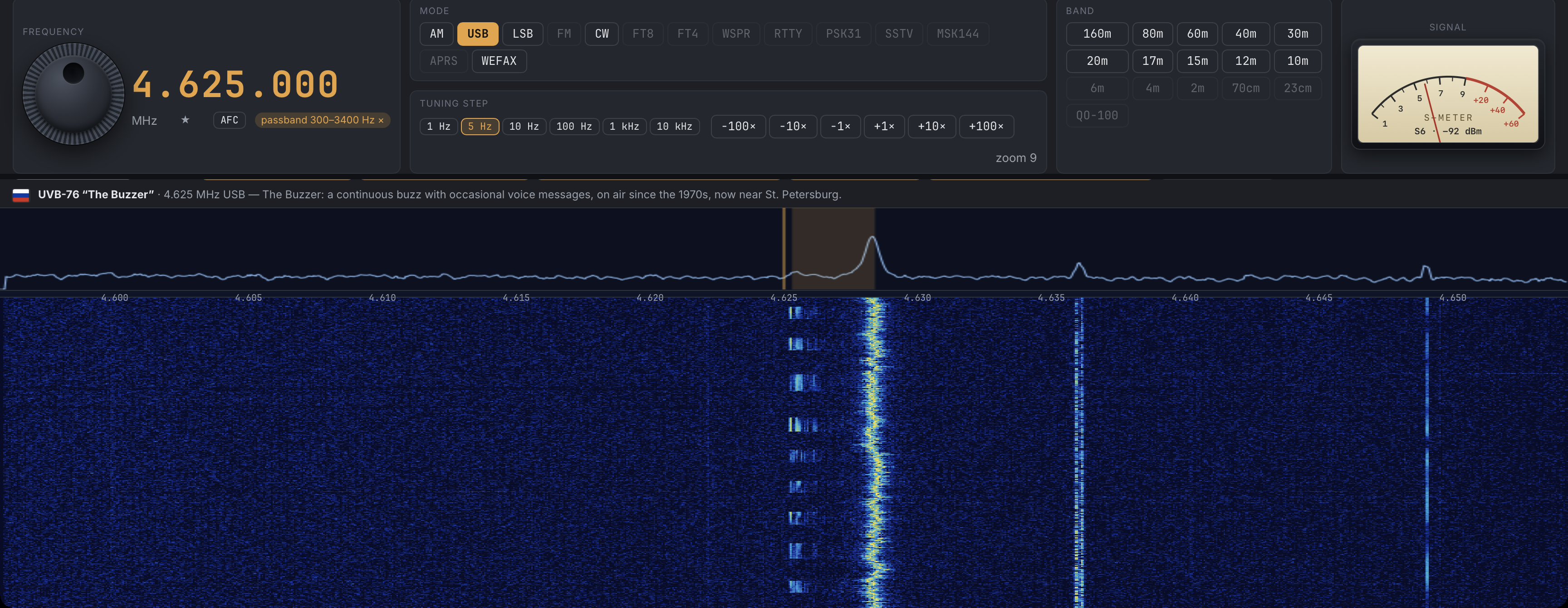
What you hear
Tune to 4625 kHz and, most hours of the day, you will hear the same thing listeners have heard since the early 1980s: a short, rasping tone about a second long, then a pause, then the tone again, roughly twenty-five times a minute. There is no music, no announcer, no identification for hours on end. The sound is dull enough that a casual listener moves on, which is exactly why the station became a legend among those who stayed.
The tone is not a recording looped forever. It is produced live, and the proof is in the background: now and then a door closes, a telephone rings, or a voice talks across the room, and the buzz keeps going through it. Several times a year, and in some years far more often, the buzzing stops and a man reads a short message in Russian: a callsign, a word, and groups of numbers, each repeated. Then the buzz returns as if nothing happened.
What is known
The callsign the station used in the 1980s and 1990s was UVB-76, and that is the name the world knows it by, although the callsign in the messages has changed several times since 2010. Listeners outside Russia named it the Buzzer, and the Russian nickname, Zhuzhzhalka, means the same thing.
The purpose has never been stated by anyone in a position to know. What can be said from the signal itself is this: the buzz is a channel marker. It keeps the frequency occupied, tells anyone meant to be listening that the channel is alive, and makes it obvious when somebody else transmits on it. The voice messages have the shape of military traffic: a callsign for the net, a code word, number groups. The station is generally believed to belong to the Russian armed forces, and the transmitter has moved at least once in its life, from a site north of Moscow to the north-west of the country.
Everything beyond that, from the stories of a dead-hand doomsday system to the idea that the buzz measures the ionosphere, is speculation. The station has survived all of it without changing its routine.
When and where to listen
4625 kHz sits between the 80 and 60 metre amateur bands, and it behaves like them: in daylight the signal is heard a few hundred kilometres from the transmitter, after dark it reaches all of Europe and often further. From western Europe the best hours are from dusk until a couple of hours after sunrise. Receivers in Sweden, Finland, Poland and the Baltic states hear it loudest; from Germany and the Netherlands it is weaker but steady at night.
The transmitter works in a mode close to AM, and most listeners use upper sideband so that the buzz comes out clean and the carrier stays below the audio. If the tone sounds wrong, try AM.
Two things are worth knowing before you spend an evening on it. The frequency attracts pirates: because the station is famous, people play music or talk over it, and an unexpected tune is almost always someone else, not the Buzzer changing its ways. And the voice messages come without warning, so the only way to catch one is to leave the receiver on and keep an ear on it.
In ShackDeck
Open the station catalogue, choose Mystery stations and click UVB-76. The program finds a public receiver that hears 4625 kHz, tunes it, sets the mode and shows the waterfall; the buzz is visible as a stripe before you even turn up the sound. If the receiver it picked is busy, it moves to the next one. No antenna, no radio and no account are needed.